| Entries |
| B |
|
Balaban & Katz
|
|
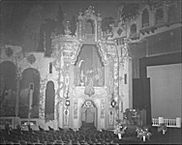
In 1925 B&K merged with Famous Players–Lasky Studio to become the cornerstone of the national Publix chain. Its success lasted until 1946, when federal action dismantled vertical integration in the film industry.
The Electronic Encyclopedia of Chicago © 2005 Chicago Historical Society.
The Encyclopedia of Chicago © 2004 The Newberry Library. All Rights Reserved. Portions are copyrighted by other institutions and individuals. Additional information on copyright and permissions.
The Encyclopedia of Chicago © 2004 The Newberry Library. All Rights Reserved. Portions are copyrighted by other institutions and individuals. Additional information on copyright and permissions.