| Entries |
| W |
|
Women in the Garment Industries
|
|
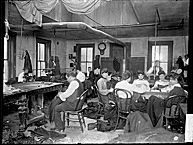
In the factories they constantly make deductions on the flimsiest pretexts. For example, there's a company on Wabash Avenue. They employ “80 hands for overalls,” trousers made from stiff material. The machines are steam powered and most of them are old and on their last legs. Often when you have to double-stitch, the needle breaks off. One of these costs 50 cents, and the girls have to pay for it themselves whether it was their fault or not....
The worst is that the factories usually don't have light, and slowly but surely the women ruin their eyesight. It's as bad in the evening as it is during the day. The gasometer is turned down to half pressure, and the flame is barely as big as a match.... An overall seamstress makes $4 to $5 if she's good.... Most live with their parents. But a lot of them have to “board” ...and the cheapest is $3 a week—if, that is, you share a room with another girl.
Keil, Hartmut, and John B. Jentz, eds. German Workers in Chicago: A Documentary History of Working-Class Culture from 1850 to World War I. 1988, 80–81.
The Encyclopedia of Chicago © 2004 The Newberry Library. All Rights Reserved. Portions are copyrighted by other institutions and individuals. Additional information on copyright and permissions.