| MAPS : MAPS CREATED BY ENCYCLOPEDIA STAFF |
| N |
|
Neighborhood Change: Chicago's Prairie Avenue, 1853-2003
|
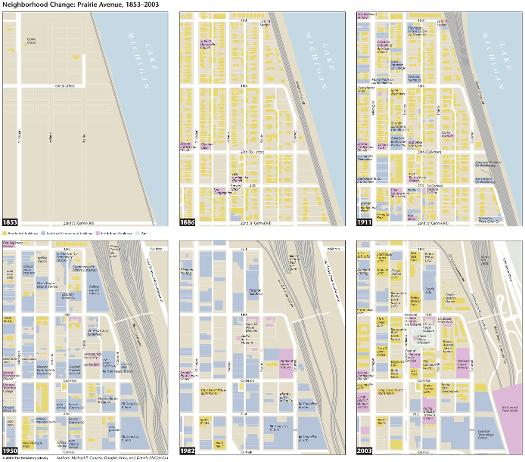
From elite section to factory district and back to upscale neighborhood, Prairie Avenue and its environs have seen massive cycles of urban investment, decay, and revalorization. In 1853 the area was only partly subdivided in anticipation of residential development, being almost a mile beyond the southern edge of town. Just one grand villa had been built. By 1877, following the Great Chicago Fire, the 11-block area had largely filled up with mansions on Prairie and Calumet Avenues, while Indiana Avenue received a more mixed stock of row houses and detached residences. By 1886, Prairie Avenue was home to many of the city's richest families, and every mansion had its own carriage house. By 1911 the spread of manufacturing close to the South Side railroad yards brought warehouses and factories to the margins of the Prairie Avenue district, and the elite began to depart. A few mansions were converted for boarders or for nonresidential uses or knocked down for more factories. By 1950 large industrial structures dominated the district, and the sites of many former mansions stood vacant. As of 2003, the area was again being transformed. Deindustrialization and urban congestion pushed manufacturing from the area. Some factories were demolished, others converted to trendy loft apartment buildings. The few surviving, much neglected mansions were restored or renovated and declared a city historic district, while new infill housing colonized the vacant spaces in between.
The Electronic Encyclopedia of Chicago © 2005 Chicago Historical Society.
The Encyclopedia of Chicago © 2004 The Newberry Library. All Rights Reserved. Portions are copyrighted by other institutions and individuals. Additional information on copyright and permissions.
The Encyclopedia of Chicago © 2004 The Newberry Library. All Rights Reserved. Portions are copyrighted by other institutions and individuals. Additional information on copyright and permissions.