| MAPS : MAPS CREATED BY ENCYCLOPEDIA STAFF |
| C |
|
Chicago's Street Railways in 1890
|
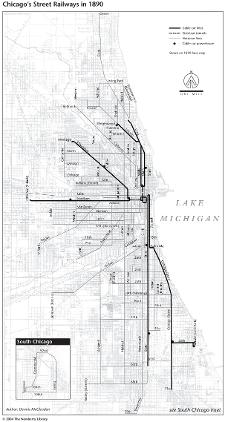
Chicago grew by leaps and bounds and by 1890 was a sprawling metropolis, its residents held together by an intricate system of street railways. Public transit began with omnibus service on some major streets in the 1850s and quickly evolved into an extensive network of horsecar lines. Chicago's street railway companies adopted the cable car as an improvement to horsecar service, not as a separate network. Feeder cars pulled by horses were often attached to cable cars to be pulled downtown. Unable to cross movable bridges, the cable car systems took over or constructed three tunnels under the Chicago River. By 1890, the network was the world's largest, covering approximately 38 route miles and failing to penetrate only the southwestern and northernmost districts of the city. Beginning in 1892, electric traction quickly replaced the complicated cable technology, and Chicago's last cable car ran in 1906. It was this system, ultimately switching from streetcars to buses, that solved the problem of transporting hundreds of thousands of daily commuters to work across the vast face of the city.
The Electronic Encyclopedia of Chicago © 2005 Chicago Historical Society.
The Encyclopedia of Chicago © 2004 The Newberry Library. All Rights Reserved. Portions are copyrighted by other institutions and individuals. Additional information on copyright and permissions.
The Encyclopedia of Chicago © 2004 The Newberry Library. All Rights Reserved. Portions are copyrighted by other institutions and individuals. Additional information on copyright and permissions.