|
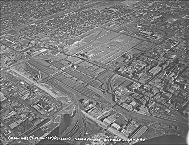
Aerial: Union Stock Yard, 1936
|
This company, which ran the huge stockyards that made Chicago the center of the American meat industry for decades, was organized during the Civil War by a group of Chicago meatpackers and railroad executives that included Rosell Hough and John Hancock. On Christmas Day, 1865, the Union Stock Yard—a 320-acre facility on Chicago's South Side—was opened. For many years, Union Stock Yard & Transit was managed by John B. Sherman, a veteran of the livestock industry. By the beginning of the 1890s, when the Union Stock Yard could hold more than 400,000 live animals at a time, the company employed about 1,000 people to help run the facility, which housed the plants of leading Chicago-based meat companies such as Swift and Armour. Between 1865 and 1900, about 400 million animals were killed within the confines of the yards. The company's workforce grew to 2,000 by the beginning of the 1920s. Just as America's railroad system had helped to centralize the meatpacking industry after the Civil War, the post–World War II highway system and trucking industry worked to disperse operations as the twentieth century progressed. Faster, more modern transportation methods made it cheaper to slaughter animals where they were raised—in western states, such as Nebraska, Kansas, Iowa, Colorado, and Montana—before shipping them for sale. The major meat companies joined toge- ther to resist the change for a time. Eventually, Swift and Armour acquiesced and left the Union Stock Yard in the late 1950s, effectively relegating the historical yards to a minor po sition in the meat industry. The Union Stock Yard completely stopped operations in 1971.
This entry is part of the Encyclopedia's
Dictionary of Leading Chicago Businesses (1820-2000)
that was prepared by Mark R. Wilson, with additional contributions from Stephen R. Porter and Janice L. Reiff.
|