|
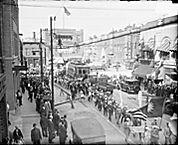
Parade in Chinatown, 1928
|
In 1890, 25 percent of the city's 600
Chinese
lived along Clark between Van Buren and Harrison Streets, in an area called the
Loop's
Chinatown. After 1910 Chinese from the Loop moved to a new area near Cermak Road and Wentworth Avenue, mainly for cheaper rent. Chinatown expanded before 1980 into
Armour Square
and by 1990 into
Bridgeport.
In 2000 Chicago had 32,187 Chinese residents, 33 percent of whom lived in Chinatown and adjacent areas.
Chinese have also concentrated in the so-called New Chinatown area, centered along Argyle Street between Sheridan Road and Broadway in
Uptown.
There were more
Vietnamese
than Chinese there in 2000, with smaller numbers of and
Koreans
as well.
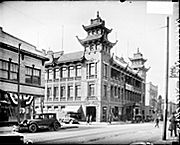
On Leong Merchants Assoc. Building
|
For decades, Chinatown has been a unique tourist attraction in Chicago. A colorful gate decorated with a Chinese inscription declaring “The world is for all” stands at the intersection of Cermak Road and Wentworth Avenue. Nearby is a landmark of Chinese architecture, the former Chinese Merchants Association Building. Adorned with red and green pagodas, flowers, and lion sculptures, the building houses a library, meeting rooms, and a shrine. The Chinatown Square mall located near Archer and Wentworth Avenues has a pagoda structure and 12 statues representing the animals of the Chinese zodiac. Tourists shop for oriental gifts or
groceries
or enjoy Chinese food; along Wentworth Avenue between 22nd and 24th Streets there are at least 30 Chinese
restaurants.
Printers and bakeries are found in the commercial areas along Wentworth Avenue and Cermak Road.
Chinatown is fragmented by many
transportation
lines. The New York Central
Railroad
and the Dan Ryan
Expressway
parallel its east boundary closely. The Santa Fe Railroad parallels the South Branch of the
Chicago River,
which forms its northwest boundary. The Pennsylvania Railroad cuts Chinatown from north to south along Canal Street. The Stevenson Expressway cuts Chinatown from east to west along 26th Street.
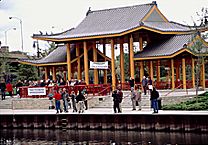
Friends of the River Canoe Race, c.2000
|
Chinatown is overcrowded. The residential areas have mostly two-story structures, both old and new. High-rises include the Archer Court and Chinatown Elderly apartments for low-income seniors. In response to a critical shortage of open space, the city of Chicago is building a 12-acre park along the east bank of the South Branch of the Chicago River from 16th to 21st Streets. The park has an indoor
swimming
pool, playing fields, a Chinese teahouse pavilion, and rose
garden.
Ying-cheng (Harry) Kiang
Bibliography
Kiang, Harry.
Chicago's Chinatown.
1992.
|