| Entries |
| A |
|
Alleys
|
|
|
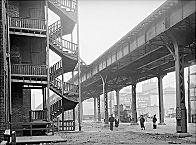
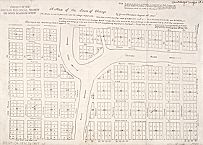
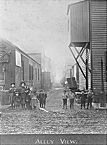
Alleys developed social meanings early on. In middle-class areas, the street represented the respectable front, while the alley saw the servants and suppliers do the dirty work. In working-class areas, alleys provided space for small manufacturing, repair shops, rear houses, children's play space, and, eventually, garages. Much of Chicago's elevated rapid transit system came to run along alleys.
|
Bibliography
Abbott, Edith.
The Tenements of Chicago, 1908–1935.
1936.
Clay, Grady.
Being a Disquisition upon the Origins, Natural Disposition, and Occurrences in the American Scene of Alleys.
1978.
The Electronic Encyclopedia of Chicago © 2005 Chicago Historical Society.
The Encyclopedia of Chicago © 2004 The Newberry Library. All Rights Reserved. Portions are copyrighted by other institutions and individuals. Additional information on copyright and permissions.
The Encyclopedia of Chicago © 2004 The Newberry Library. All Rights Reserved. Portions are copyrighted by other institutions and individuals. Additional information on copyright and permissions.